As of April 2023, instead of using a single flat rate, the UK has been using an apportioned Corporation Tax structure. This means that the rate you pay is determined by the amount of earnings your business generates. Understanding different corporation tax rates is fundamental for business owners to understand as it is the key to effective Corporation Tax Planning. This article will be explaining each rate in clear, simple terms and outlining how they work together.
What is Corporation Tax?:
All UK limited companies must pay corporation tax as long as they are making a profit. These profits may come from several sources of income such as sales, investments, trade, or gains on the sale of assets. There are numerous criteria that need be considered when determining corporation tax, but companies that break even or are losing money at the end of their accounting period will not be required to pay any corporation tax and may be able to carry forward any losses in order to offset any tax in the future.
The relevant Corporation Tax rate is applied based on the company's profit level for the accounting period once profits have been calculated.
The Small Profits Rate (19%)
The Small Profit Rates applies to all UK businesses that have made a profit of £50,000 or less within the accounting period. This rate is intended to benefit small business by lowering their corporation tax lability. If your company is making £50,000 or less within your accounting period, you will only be required to pay a flat rate of 19% with no apportioned calculations needed.
It is vital to remember that if your business has any associated companies, the £50,000 amount is decreased. In those circumstances, the threshold is divided by the number of associated companies.
The Main Tax Rate (25%)
Any company that is making over £250,000 in profit is required to pay the main corporation tax rate which is 25%. This is currently UK's highest corporation tax rate with no marginal rate relief relief available.
Similarly to the Small Profits level, if a corporation has any associated companies, the £250,000 threshold may be lowered. Companies may be charged the main tax rate at a lower amount of earnings than originally planned since the threshold is split among the associated companies. Because of this, it is crucial for businesses with shared ownership to take into account these effects when evaluating their corporation tax status.
Marginal Rate Relief (MRR):
Marginal rate relief is applicable to all businesses with profits between £50,001 and £250,000. This means that there is no set tax rate for marginal rate relief. Instead, it is a method that enables a steady transition between the Small Profits Rate and the Main Rate, rather than a dramatic rise from 19% to 25%.
Under the marginal rate relief, corporations may apply a tax relief that lowers the total amount of tax due after first calculating Corporation Tax at the main tax rate (25%). The closer profits are near £50,000, the closer the effective tax rate will be to 19%. The effective rate progressively becomes closer to 25% as profits rise towards £250,000.
It is important to understand that not every business qualifies for marginal rate relief. The relief is not available if your business is a close investment holding company or if it does is not incorporated in the United Kingdom but still liable for corporation tax.
How to calculate your Marginal Rate Relief:
The first step in calculating the marginal rate relief is to divide your accounting period by the number of years that it falls across. Remember that, for corporation tax purposes, a financial year for HMRC purposes is from April 1st to March 31st. Your Company accounting or reporting year will generally depend on when it was incorporated, so will probably straddle to financial years.
The number of days in each financial year is then used to divide your taxable profits. The 19% tax will still apply to any days that fall during the financial period that ends on or before March 31, 2023.
For any profit that occurs after the 1st April 2023, it will be taxed according to the amount of taxable earnings that your company has made (once all your expenses and other allowances have been take into account).
Calculation in EDF and also how it is displayed in the CT600:
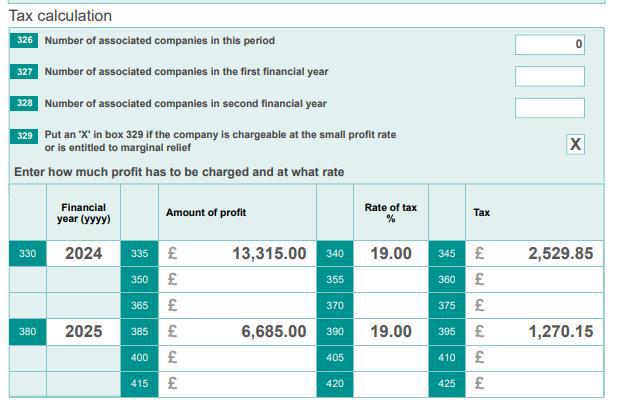
1) You will be subject to the 19% small profit rate if your taxable profits are £50K or less. Your corporation tax calculation under the small profits rate will be presented in your CT600 as shown below (the example below is based on profits of £20K).
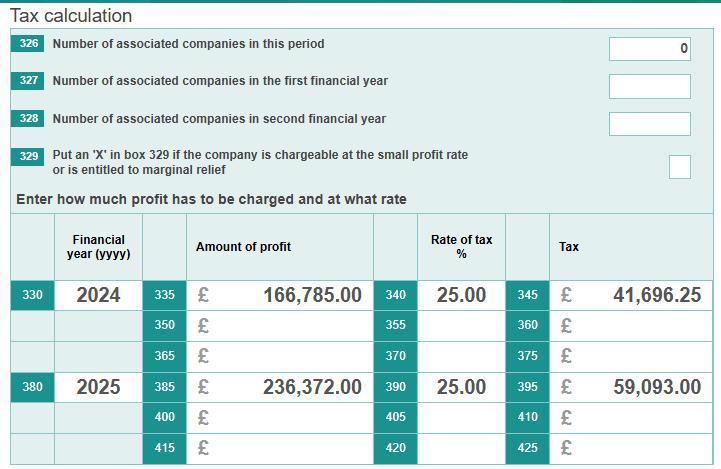
2) If your profits exceed £250K after April 1, 2023, you will be subject to a 25% tax. Neither the small profits rate of 19% or the marginal rate relief will not be applied because your taxable profits exceed the threshold. This is how your company tax computation will appear (based on profits of £300K).
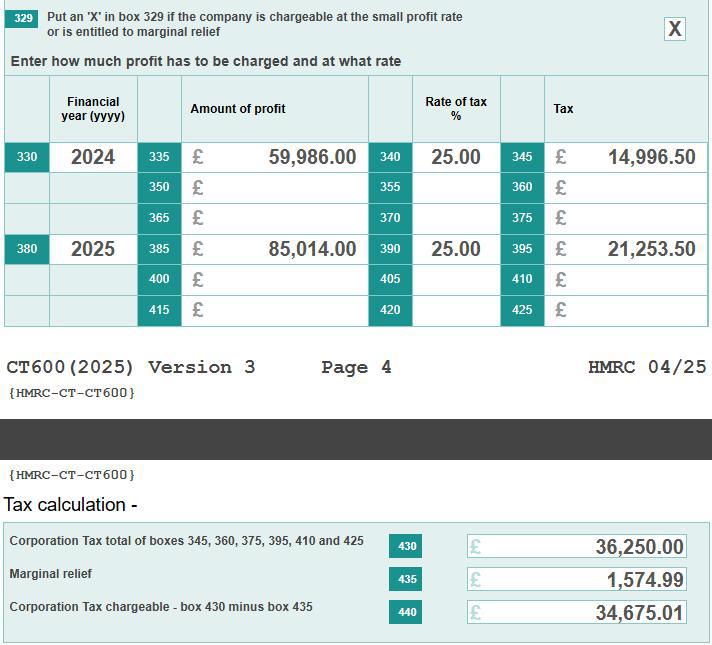
3) If your taxable profits exceed £50K but fall below £250K after April 1st, 2023, you will be eligible for the marginal rate relief. The result will be a sliding scale where the company tax percentage gradually increases. This is how your company tax computation will appear (based on profits of £145K)
The good new is, you will not need to calculate these complex computations yourself because they will all be automatically calculated through our software. To get started, please feel free to create an account here: https://easydigitalfiling.com/public/register!
For more information, please follow this link: https://easydigitalfiling.com/kb/corporation-tax-increase-in-corporation-tax