£100k Take-Home Pay: The Best Salary and Dividend Split for Company Directors in 2025/26
How can Directors keep more of their hard earned company profit?
It has been a tough year to run a business in the UK. Costs keep climbing, customers are more cautious, and support for small businesses has been scarce. Then the tax bill arrives. Employer NICs went up to 15%, dividend tax rose again in April 2026, and personal allowances are frozen while everything else gets more expensive.
You’ve taken the risk, put in the long hours and made it to £100,000 company profit. So how much of it do you actually keep? Does that mean you get £100k take-home pay? Unfortunately not, however how much you get to keep depends on how you pay yourself as a director; most directors never compare the options. We compare the difference between salary vs dividends.
The Director With £100k Profit
Your company makes £100,000 profit before corporation tax and before any director pay. How much ends up in your pocket? Is is best for it to be paid as director by dividends, directors salary or a mix of both?
A limited company generally pays Corporation Tax on its taxable profits. If you receive a salary, your company must also consider employer National Insurance contributions, while you will have Income Tax and employee National Insurance to pay. Dividends are paid from company profits, that are available for distribution after Corporation Tax has been paid. Dividends are generally subject to personal dividend tax.
The main ways to distribute director's pay are as follows:
- Salary and dividends: Pay yourself a director's salary and take additional income as dividends.
- Salary only: Receive your remuneration through PAYE, potentially incurring Income Tax and National Insurance.
- Dividends only: Take distributions from available post-tax company profits, subject to the relevant legal and tax requirements.
- Salary, dividends and pension contributions: Combine current income with employer pension contributions to support longer-term financial planning.
The table below compares the first 3 options of salary vs dividends for director's pay (based on £100k profit) :
Route | Take-Home | Total Tax (£) | Effective Rate (%) |
| £12,570 Salary + Dividends | £66.5 | £33.6k | 33.6% |
| £5,000 Salary + Dividends | £65.8k | £34.2k | 34.2% |
| Dividends Only | £64.8k | £35.24k | 35.2% |
| All Salary via PAYE | £61.4k | £38.6k | 38.6% |
*Total tax includes corporation tax, employer NICs, income tax, employee NICs and dividend tax. Assumes a sole director in England, Wales or Northern Ireland, with no other income, no associated companies, no Employment Allowance, and all profit extracted.
Even with the most tax efficient option for 100K profit, over a third of what your company profit goes to the Government. The choices above are about keeping as much of it as you legitimately can.
The Rates Behind the Tax Calculation
For tax year ending April 2026
- Corporation Tax: 19% up to £50k, 25% above £250k, with marginal relief in between. At £100k profit you sit in the marginal relief band.
- Dividend Tax: 8.75% basic rate and 35.75% higher rate, after a £500 allowance. Both rates rose by 2% in April 2026.
- Employer NICs: 15% on salary above £5,000. Dividends carry no NICs.
The Salary Trade-Off
Paying yourself as a director through salary reduces the company’s corporation tax bill, because it’s a deductible expense. However, the more you pay yourself, the more you pay in income tax and eventually higher-rate income tax at 40% (45% for additional rate payers). Employer and employee NICs apply too. That’s why the all-salary route is the worst of the four options for £100k profit. A salary of £87,430 (post £12,570 allowance) gets taxed at 20% and 40%, and costs the company 15% employer NICs on top.
The aim is to take only as much salary as it takes to use your tax-free allowances, then take the rest as dividends.
Why £12,570 + Dividends Wins
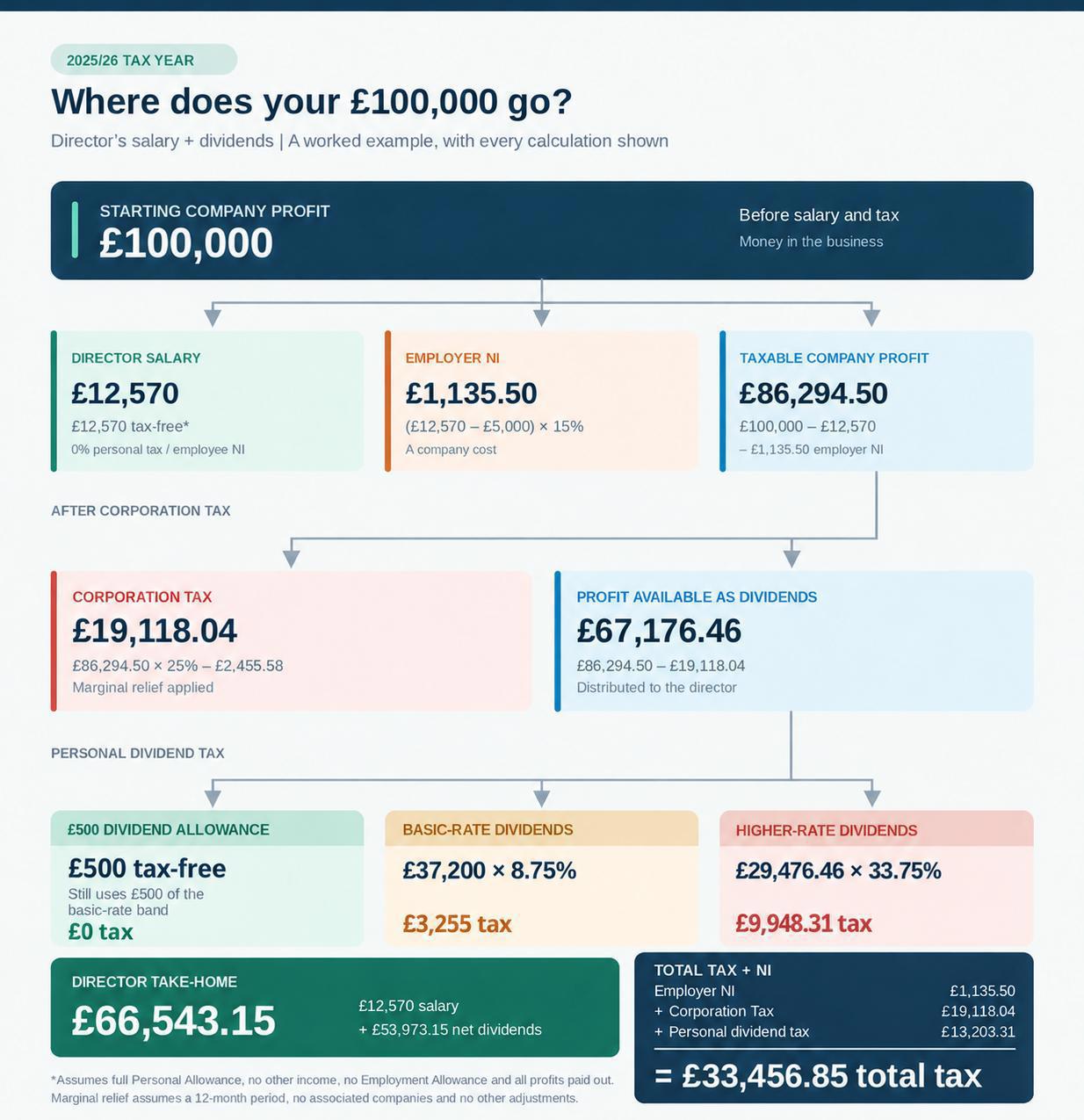
The image shows how you are taxed on £100k company profit and the most efficient way to pay yourself as a company director with a combination of salary and dividends.
Things To Remember:
- No Personal Tax: The salary uses your full personal allowance, so there is no income tax or employee NICs.
- You maybe eligible to claim the employer NI back through employment allowance
- Net Cost Is Small: The company pays about £1,135 of employer NICs, but the salary and the NICs are both deductible, reducing any corporation tax due for the period.
A Lever To Pull: Employer Pension Contributions
Your company can pay into your pension directly. It’s deductible against corporation tax, there are no NICs, and it also lowers the director dividends you pay tax on. Rather than extracting all available profits as dividends, a director might use some of the company's profits to fund retirement savings. This can reduce the amount available for immediate take-home pay while increasing the amount invested for the future.
Here is the same £100k profit with a £12,570 salary and different pension contributions:
| Employer Pension | Take-Home | In Your Pension | Pot + Take-Home | Total Tax Paid |
| £0 | £66.5k | £0 | £66.5k | £33.5k |
| £20,000 | £56.8k | £20.0k | £76.8k | £23.2k |
| £40,000 | £46.8k | £40.0k | £86.8k | £13.2k |
| £60,000 | £32k | £60.0k | £92k | £8k |
*Before tax on pension withdrawals. 25% of the pot can usually be taken tax-free, and the rest is taxed as income.
- Annual contribution allowance from the company is capped at £60,000 per annum.
- £40,000 is considered to be the sweet spot.
Other Ways To Take The £100k Profit More Efficiently
- Spread dividends across tax years. Keep dividends in the 8.75% (10.75 for tax year ending April 2027) band and leave the rest in the company.
- Use a spouse’s allowances. If your spouse is a shareholder, their unused personal and dividend allowances can be used. Best to get advice first.
- Use company paid costs. Legitimate business expenses such as electric company cars reduce profit before it’s taxed.
Does a Director's Loan help?
When cash is tight, it’s tempting to treat the company like a bank account.
A director's loan arises when you borrow money from your company other than through properly recorded salary, dividends or expense reimbursements.
If a director's loan account becomes overdrawn, there can be tax consequences. For example, a close company may face a Section 455 Corporation Tax charge if a relevant loan remains outstanding nine months and one day after the end of the accounting period in which it was made, subject to the applicable rules.
Additional issues may arise if the loan exceeds £10,000 and is interest-free or charged at a rate below the official rate, potentially creating a taxable employment benefit.
The Bottom Line for £100k Profit, Salary vs Dividends
- Best route for director pay: £12,570 salary plus dividends, about £3,800 better than paying yourself the same cost as PAYE salary (£61.4k).
- Salary cuts corporation tax, but only up to a point. Beyond the personal allowance, extra salary attracts income tax and employer NICs.
- Biggest lever: Employer pension contributions.