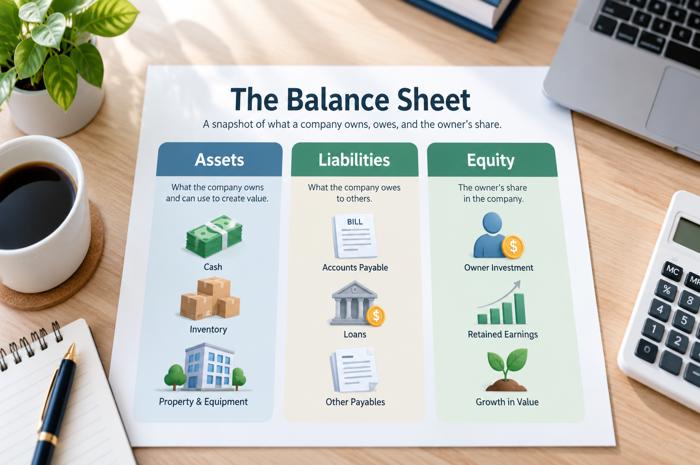
Whether you are a business owner, investor, student, or simply trying to understand company finances, learning how to read a balance sheet can give you a clearer picture of a company's financial position.
What Is a Balance Sheet?
A balance sheet is a financial snapshot of a business on a particular date. Unlike an income statement, which shows revenue and expenses over a period, a balance sheet shows the company's financial position at one specific moment. For example, a balance sheet dated 31 December 2026 tells you what the business owned, owed, and had invested in it on that date.
A balance sheet is built around three main categories:
- Company assets – what the business owns or controls
- Company liabilities – what the business owes
- Equity – the value belonging to the owners
These three categories are connected by a simple accounting formula:
Assets = Liabilities + Equity
This is known as the accounting equation. It is the foundation of every balance sheet.
- Company Assets: What the Business Owns
Assets are resources that a business owns or controls and that have economic value. They can help the company generate revenue or provide benefits in the future. Company assets are usually divided into two groups: current assets and non-current assets.
Current Assets
Current assets are generally expected to be converted into cash, sold, or used within a year. Common examples include:
- Cash and cash equivalents
- Accounts receivable (money customers owe the business)
- Inventory
- Short-term investments
- Prepaid expenses
For example, if a company has £50,000 in its bank account and £20,000 worth of inventory, those amounts would contribute to its current assets.
Non-Current Assets
Non-current assets are resources expected to provide value for longer than one year. These can include:
- Buildings
- Machinery
- Vehicles
- Office equipment
- Long-term investments
- Intangible assets such as patents and trademarks
A company's assets can tell you a lot about how it operates. A manufacturer, for example, may have significant machinery and inventory, while a software company may have fewer physical assets but more intangible assets.
2. Company liabilities: What the Business Owes
Company liabilities are financial obligations that a business needs to pay to other parties. In simple terms, they represent the company's debts and other amounts it owes. Like assets, liabilities are commonly divided into current and non-current liabilities.
Current Liabilities
Current liabilities are generally due within one year. Examples include:
- Bills owed to suppliers
- Short-term loans
- Wages payable
- Taxes payable
- Other short-term obligations
Suppose a company has £30,000 in unpaid supplier invoices. That amount would normally appear as a current liability.
Non-Current Liabilities
Non-current liabilities are obligations due after more than one year. Examples include:
- Long-term bank loans
- Bonds payable
- Long-term lease obligations
- Certain pension or tax obligations
Looking at company liabilities helps you understand how much a business relies on borrowing or credit to finance its activities.
3. Equity: What Belongs to the Owners
Equity represents the owners' residual interest in the business after liabilities have been deducted from assets.
Put simply:
Equity = Assets − Liabilities
Equity can include money originally invested by shareholders, retained profits, and other components depending on the company's structure and accounting rules. For example, if a business has £500,000 in assets and £300,000 in liabilities, its equity would be £200,000.
Equity or capital and reserves does not necessarily mean the business has £200,000 sitting in its bank account. It represents the accounting value remaining after liabilities are taken into consideration.
How to Read a Balance Sheet
You do not need to be an accountant to get useful information from a balance sheet. Start by looking at the company's cash, current assets, and current liabilities.
You can then consider questions such as:
- Does the business have enough short-term assets to cover its short-term obligations?
- How much debt does the company have?
- Is equity increasing or decreasing over time?
- How much of the company's assets are financed by borrowing?
- How does the company's financial position compare with previous years?
It is often more useful to compare balance sheets from several periods rather than looking at just one. Changes over time can reveal trends that a single snapshot may not show.
Balance Sheet vs Income Statement
It is easy to confuse a balance sheet with an income statement, but they serve different purposes:
- A balance sheet shows what a business owns and owes at a specific date.
- An income statement shows revenue, expenses, and profit or loss over a particular period.
For example, an income statement might show how much profit a company generated during 2026, while its balance sheet shows its assets, liabilities, and equity at the end of 2026.
Both statements are useful because profitability does not necessarily mean a business has strong finances. A company can report a profit while still having cash-flow or debt problems.
The Bottom Line
A balance sheet is essentially a snapshot of a business' financial position. Once you understand its three main sections (assets, liabilities, and equity), the statement becomes much easier to read.
Remember the basic formula:
Assets = Liabilities + Equity
From there, you can examine what the business owns, what it owes, and how much value remains for its owners. Comparing these figures over time can also help you understand changes in a company's financial position.