
Write Down Allowance 2026: What the New 14% Rate Means for Your Corporation Tax
From 1 April 2026, HMRC introduced several important changes affecting corporation tax, including updates to capital allowances, late filing penalties and tax rates.
One of the biggest changes for many limited companies is the reduction in the Write Down Allowance (WDA) for main pool assets, which falls from 18% to 14% for accounting periods beginning on or after 1 April 2026.
If your business purchases equipment, machinery, office furniture or certain vehicles, this change could increase your corporation tax bill over time.
In this guide, we'll explain:
- What the Write Down Allowance is
- Which assets qualify
- How the new 14% rate affects your corporation tax
- Examples showing the tax impact
- How to claim the allowance on your CT600 using Easy Digital Filing
What is a Write Down Allowance?
A Write Down Allowance (WDA) is a type of capital allowance that allows limited companies to claim tax relief on qualifying business assets over several years.
Unlike the Annual Investment Allowance (AIA) or Full Expensing, which can allow businesses to deduct 100% of an asset's cost immediately, a Write Down Allowance spreads the tax relief across multiple accounting periods.
This is particularly useful—and sometimes mandatory—for assets that do not qualify for first-year relief.
Each year, you deduct a percentage of the remaining value of the asset from your taxable profits, reducing the amount of corporation tax your company pays.
What Are Capital Allowances?
Capital allowances allow businesses to claim tax relief when purchasing long-term business assets that appear on the balance sheet rather than as an expense in the profit and loss account.
Instead of deducting the full purchase price as a business expense, HMRC allows companies to claim tax relief through different capital allowance schemes.
The most common include:
- Annual Investment Allowance (AIA)
- Full Expensing
- First-Year Allowances
- Write Down Allowance (WDA)
The most suitable allowance depends on the type of asset purchased and whether it qualifies for enhanced relief.
Which Assets Qualify for the Write Down Allowance?
Write Down Allowances are divided into two pools.
Main Pool Assets
Typical main pool assets include:
- Office furniture
- Computers and IT equipment
- Machinery
- Plant and equipment
- Fixtures and fittings
- Security systems
- Certain commercial vehicles
- Some second-hand cars
For accounting periods beginning:
Before 1 April 2026 – the rate is 18%
From 1 April 2026 – the rate reduces to 14%
Special Rate Pool Assets
Assets that qualify for the Special Rate Pool include:
- Air conditioning systems
- Heating systems
- Water systems
- Electrical and lighting installations
- Certain low-emission cars
- Other integral features within buildings
These continue to receive a 6% Write Down Allowance.
How Does the New 14% Write Down Allowance Affect Corporation Tax?
Because a Write Down Allowance reduces your taxable profits, a lower percentage means less tax relief each year. As a result, companies claiming the allowance will generally pay more corporation tax than under the previous 18% rate.
Example
Suppose your company has:
Turnover: £1,500
Allowable expenses: £800
Taxable profit before capital allowances: £700
Corporation tax at 19%: £133
Now assume the company purchased a qualifying second-hand business car costing £2,000.
Under the old 18% rate
Write Down Allowance: £360
New taxable profit: £340
Corporation tax: £64.60
Under the new 14% rate
Write Down Allowance: £280
New taxable profit: £420
Corporation tax: £79.80
Although this example increases corporation tax by only £15.20, businesses purchasing higher-value assets will see a much greater impact over time.
What If My Accounting Period Crosses 1 April 2026
If your accounting period starts before 1 April 2026 but ends afterwards, HMRC requires the Write Down Allowance rate to be apportioned.
How do I complete a capital allowance claim through Easy Digital Filing?
We offer several capital allowance claims through our software, including the write down allowance. To claim write down allowance:
- Open your CT600 Return.
- Navigate to CT600 Sections.
- Switch Box 105 to Yes.
- The Capital Allowances section will appear.
- Click the + icon.
- Select Write Down Allowance from the available options.
- Enter your qualifying expenditure.
If this is your first year claiming the allowance, enter the qualifying asset within Box Q15.
If you're continuing a claim from previous years, enter the brought forward balance within Box Q10 instead.
The software automatically:
- Calculates the correct allowance rate
- Applies the new 14% rules where appropriate
- Automatically apportions claims spanning 1 April 2026
- Carries forward the remaining balance to future accounting periods
This removes the need for manual calculations and helps ensure your CT600 is completed accurately.
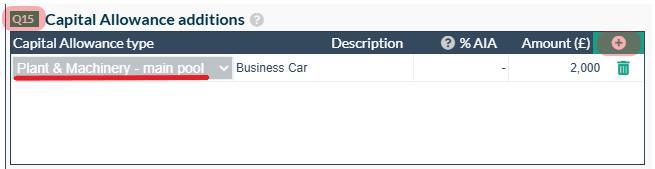
If this is the second year, or you have already been carrying forward your write down allowance over several years, then you can just add this within box Q10 instead. You just need to click on the ‘+’ icon, select the capital allowance type, and then enter the carried forward amount you can still claim next to it.
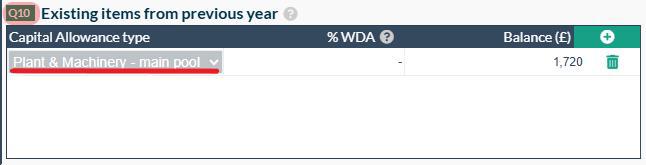
Our software will automatically calculate the capital allowance rate based on the period you entered in boxes 30 and 25 in the Return Information page, and the capital allowance type you selected. You can keep carrying forward and claiming the write down allowance until the claim is fully written off, meaning you have eventually claimed the full cost of the item.
Frequently Asked Questions
What is the Write Down Allowance rate for 2026?
For accounting periods beginning on or after 1 April 2026, the Write Down Allowance for main pool assets reduces from 18% to 14%. Special rate pool assets remain at 6%.
Can I still claim 100% of an asset?
Yes. Many qualifying assets can still be claimed under the Annual Investment Allowance (AIA) or Full Expensing, depending on the asset and your circumstances.
Which businesses can claim Write Down Allowances?
Most UK limited companies and businesses subject to corporation tax can claim Write Down Allowances on qualifying capital assets that do not qualify for full first-year relief.
Does Easy Digital Filing calculate the new rates automatically?
Yes. Easy Digital Filing automatically applies the correct Write Down Allowance rate based on your accounting period and apportions claims where required.
Hopefully you should now have a better understanding of the write down allowance, how the rate change will impact your company, and how to claim capital allowances through Easy Digital Filing! For more on claiming capital allowances, please read our article ‘How to claim capital allowances on a corporation tax CT600 return’ on our Knowledge Base.