
The numbers don't lie. UK small businesses are carrying more debt than they were a year ago, and the year before that. The question is not whether borrowing is rising; It's why UK businesses are taking on more debt, where that borrowing is coming from, and what it means for the future of SMEs.
For small and medium-sized businesses in particular, access to finance remains a significant challenge. Rising costs, higher interest rates, depleted cash reserves and tighter lending criteria have created a difficult environment for small businesses that need capital to survive, invest or grow.
The picture is clear: UK businesses are under increasing financial pressure, while access to affordable business finance isn't keeping pace with demand.
Not Business As Usual - UK Business Debt
Running a small business in the UK right now isn't easy. Between persistent inflation, elevated interest rates, rises in employment costs, electricity costs increase, SMEs now have a cost base that looks very different to five years ago, businesses of all sizes are being squeezed from multiple directions. For many, the question isn't whether to borrow - it's whether they even can.
This report looks at the UK lending landscape and how this affects small businesses, why access to capital remains a genuine problem for small and medium-sized businesses, and what the data from our own customer base suggests about how businesses are actually responding. The picture that emerges is one of growing financial pressure, and a debt market that isn't keeping pace with the need.
Setting The Scene: The UK Business Lending Landscape
COVID-19 didn't just squeeze small businesses; for some, it opened a door. As the Bank of England (BoE) cut interest rates to historic lows, opportunistic business owners saw a chance to borrow while it was effectively free.
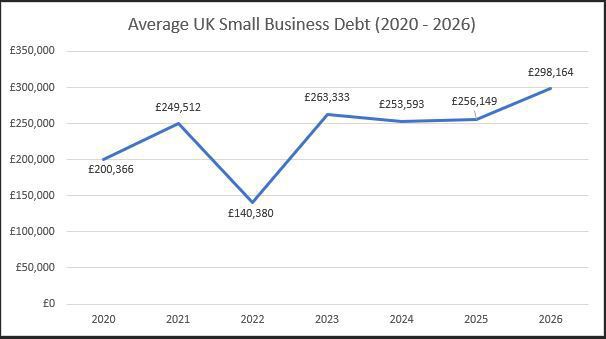
*Analysis based on average debt levels across 10,903 UK SMEs over the period.
Between March 2020 and early 2021, the BoE cut its base rate from 0.75% to 0.25%, then to just 0.1%, the lowest in its 325-year history. Many small businesses took full advantage, loading up on cheap debt. SME borrowing peaked in 2021, with the average SME carrying around £250,000 in debt, just before the BoE began reversing course that December.
What followed, was one of the sharpest tightening cycles the UK had seen for decades. Rates climbed from 0.25% to 3.5% over the course of 2022 alone, as the BoE moved to rein in post-pandemic inflation. Cheap borrowing was over, the appetite for debt cooled, and average SME debt fell back to £140,380.
Then came the Bounce Back Loan Scheme - the Government's 0% lifeline for struggling SMEs, offering up to £50,000 interest-free for the first year. By 2023, once those loans were reflected in the balance sheet of filed accounts, average SME debt had climbed again, to £263,333.
Debt eased slightly through 2024 and 2025, but by 2026 it had risen again to approximately £298,164. This raises an important question: why are UK businesses taking on more debt again?
The Lending Landscape: Access To Capital
Fast forward to today, and the picture has flipped. Businesses aren't borrowing because money is cheap, they are borrowing to stay afloat amid the cost-of-living squeeze.
Overall SME lending is recovering only slowly. Borrowing volumes remain below pre-pandemic levels, however, a lot of this debt is still sat on SMEs balance sheets. Many lenders still haven't loosened their criteria back to where it stood before 2020. Risk appetite among the traditional banks has not fully returned. Unfortunately, it's often the small businesses that need finance the most that are struggling; early-stage, asset-light, or in higher risk sectors, that are still getting turned away from lenders.
Part of this is structural, part is cultural. UK SMEs have long been more reluctant than many of their European peers to seek external finance in the first place, roughly 1.5% of UK SMEs apply for bank loans, against 20% of their European counterparts [1].
This difference is significant.
If business owners believe they are unlikely to qualify for finance, they may choose not to apply at all. This can result in otherwise viable small businesses delaying investment, reducing growth plans or operating with insufficient working capital.
For the UK economy, that can have wider consequences. Businesses that cannot access appropriate finance may be less likely to hire, invest, expand or take advantage of new opportunities.
So Why Are Businesses Taking On More Debt?
There is rarely a single reason a business takes on debt, but a few themes come up consistently in the current environment.
Cash Flow: Costs have risen faster than revenue for many businesses. On tight margins, the gap between money going out and money coming in stops being a blip and starts becoming permanent. Debt is what plugs it.
Growth still requires investment: Not every business borrowing right now is struggling. Some are investing into growth, hiring, buying equipment, expanding; because they see an opportunity worth funding. The catch is that capital costs far more than it used to, which makes the numbers much harder to justify.
Depleted cash reserves: Many businesses went into the pandemic with cash buffers, then spent the past few years running them down. Without that cushion, the default response to any shock is now to borrow rather than absorb it.
Tighter supplier terms: Everyone along the supply chain is under its own pressure, and the informal credit that used to smooth things over, such as longer payment windows and flexible terms is drying up. Businesses that once managed cash flow through supplier goodwill are now having to borrow formally instead.
UK Business Debt - The Bottom Line
The data points in one direction: UK businesses are taking on more debt, and the pressures driving that aren't easing off. Lending is opening up, but slowly, not fast enough, and not for everyone.
For business owners, the key issue isn't simply how much debt they have. It is what that debt is being used for and whether the business can comfortably afford it.
A company borrowing to fund profitable growth may be in a very different financial position from a company borrowing simply to pay its monthly bills. This makes maintaining a clear and up-to-date Balance Sheet, cash-flow forecast and understanding of business finances more important than ever.
For lenders and policymakers, that 20% to 1.5% gap with Europe should not be read lightly. It is a sign the UK lending system is not working as it should. Businesses locked out of capital don't take risks, don't hire, and don't grow, and that has knock-on effects well beyond any one Balance Sheet.
The businesses most likely to navigate the current environment successfully are those that have a clear understanding of their finances, maintain accurate accounts, monitor cash flow and make informed decisions about borrowing.
Citations:
[1] https://www.ecb.europa.eu/stats/ecb_surveys/safe/html/ecb.safe202501~e940f53e7c.en.html#toc3