
Staff are being let go, vacancies are going unfilled, and rising employer NICs are behind both. Since the NIC changes, taking on a new member of staff carries a heavier price tag, and for many small businesses, that price is too high. The result is a workforce that is unfortunately shrinking.
The Policy Shift:
Announced in October 2024 and landing in April 2025, the changes hit employers from two directions at once. The rate of employer NIC contributions jumped from 13.8% to 15%, while the threshold at which businesses start paying employer NI dropped sharply; from £9,100 down to £5,000. More contributions, on more of the workforce.
The sectors feeling it most are those that run on part-time and lower-wage workers. Industries such as hospitality, retail, leisure, and care. For a large business, the additional cost is manageable. For a small business built around part-time staff, it is the difference between a viable payroll and one that no longer adds up.
Lets look at the statistics:
H2 2024 — The Announcement:
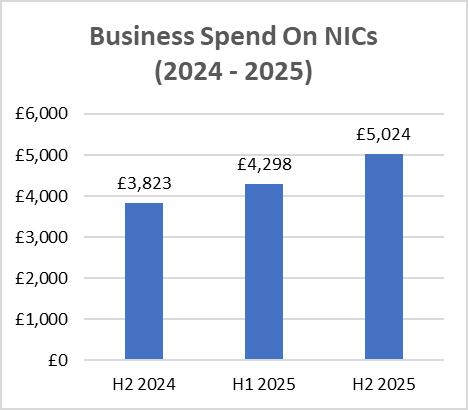
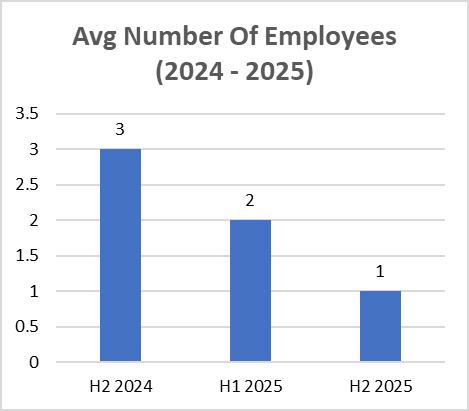
Average Small Medium Enterprise (SME) Employer NIC Spend: £3,823 Average No of Employees: 3
Heading into H2 2024, the average SME was spending £3,823 a year on employer NICs across a workforce of three people. These were modest figures, but ones that were about to change significantly. The broader business landscape was steady, even if a little cautious. Labour's general election win in July meant there was a natural period of adjustment for small business owners, but hiring was ticking along and payroll costs were predictable. Growth was slow, but it was growth.
That changed in October 2024. When Rachel Reeves, Chancellor of the Exchequer made her budget announcement, business confidence amongst small businesses dropped and the cautious optimism of Q3 gave way to a much bleaker Q4 outlook. The employee numbers and cost had not changed yet, but the direction was clear, and businesses began to act accordingly.
H1 2025 — The Transition:
Average SME NIC Spend: £4,298 Average No of Employees: 2
April 2025 marked the moment the numbers stopped being theoretical. With Reeves' changes now in place, the average SMEs annual NIC bill jumped from £3,823 to £4,298; an immediate and unavoidable hit. The workforce data tells the next part of the story: average employee numbers dropped from 3 to 2. For small businesses, that is not a minor adjustment, it is a 33% reduction of the workforce.
The reality for many SMEs was harsh. Margins were already thin before April, and the additional cost simply could not be absorbed. It all played out in a familiar pattern: hiring freezes, reduced hours, then inevitably letting employees go. For businesses operating with little to no financial cushion, dismissing staff was not a strategic decision, it was the only one available.
H2 2025 — The Full Impact:
Avg SME NIC Spend: £5,024 Avg No of Employees: 1
By H2 2025 the average SME NIC bill climbed again to £5,024, up from £4,298 the previous half, with average employee numbers falling to just 1. From 3 employees to 1 in the space of a year. That is the difference between a functioning team and a sole trader.
The trend is no longer emerging; it is fully embedded. Rising employer NICs and a shrinking workforce are moving as one, and the direction is clear. Every increase in employer NIC costs has been met with a corresponding reduction in headcount. Any plans for growth, new hires, or expansion have been put on pause. SMEs are now looking to survive, rather than be ambitious.
The two graphs below make the correlation impossible to ignore. As NIC costs climb, employee numbers fall. This is a direct response to the changes Reeves introduced.
Why Employees Bear The Brunt:
Employer NICs are a per employee cost. So, when the rate goes up, the most rational response for a business is to reduce its workforce. For SMEs, that logic played out exactly as the data suggests. Wage freezes were off the table with Reeves deciding to increase the minimum wage at the same time. Fixed overheads such as rent and rates offered no relief. Things such as automation which is an attractive long-term solution, is not something a small business can typically implement in a matter of months.
The government at the same time to try and soften the blow of the increased employer NIC by increased employment allowance from £5,000 to £10,500. This initiative, does not appear to be helping.
Employee numbers are the only variable. Not because they were the easy target, but because they were the only option. Rising NICs created a pressure point which could only be relieved one way, and thousands of small business owners took it.
Can It Go On Like This?
The data covering H2 2024 to H2 2025 paints a clear picture, but the more pressing question is what comes next? If NIC rates and thresholds remain where they are, the trajectory for SME employment over the next 12 to 24 months is difficult to look at with any optimism. Businesses that have already stripped back their workforce have nowhere left to cut. The next step is not cutting employee numbers; it is closing the door entirely.
Writing in May 2026, the political backdrop is noteworthy. The Labour Government is polling poorly, and pressure for economic reform is building. Whether that translates into meaningful relief for small businesses remains to be seen. SMEs cannot absorb never-ending cost increases and continue to function, let alone grow. The ambition that drives people to start and build small businesses has not gone anywhere, however, the financial conditions to act on it have.
* These figures are derived from average data across 1,111 business year-end accounts, covering the period July 2024 to December 2025 upon submission to HMRC.