Audit Exemption in the UK
Understanding the requirements for an audit exemption for limited companies in the UK is important when it comes time to submit your returns to Companies House and HMRC. For a lot of UK companies wishing to submit their annual accounts to Companies House and HMRC, they are required to provide audited accounts. However, your company may qualify for an audit exemption.
What is an audit?
Simply put, an audit is a formal examination and verification of an individual's or organisation's records and accounts, finances or compliance with set standards. Audited accounts are conducted such that they are free from any financial inaccuracy and are an accurate reflection of a companies finances for said accounting period.
Professional standards of audit require a qualification, so typically company audits are only carried about by any individual who is a qualified auditor, in most cases this is a chartered accountant. To keep with good accounting standards, it would be best that the auditor and the company are not 'related parties' and would not benefit from each other on a personal degree.
Complying with Audit Requirements
It's important to be aware if your company does not have an audit exemption and is expected to submit audited accounts. If so, the company must comply with the the UK’s audit standards. Failure to comply can lead to potential penalties or even legal action can be taken against liable directors.
Not all companies are required to have an audit for their limited company's annual accounts submission. If a company falls within either the small or micro thresholds, then you may be able to submit unaudited accounts.
Audit Exemption Clause
If you are looking to submit unaudited accounts, the returns must include an audit exemption clause that must be clearly displayed as part of the Balance Sheet.
As per HMRC and Companies Houses requirements, the following statements must be included as part of the audit exemption clause:
For the year ending [your company’s year end date], the company was entitled to exemption from audit under section 477 of the Companies Act 2006 relating to small companies.
The members have not required the company to obtain an audit of its accounts for the year in question in accordance with section 476.
The directors acknowledge their responsibilities for complying with the requirements of the Act with respect to accounting records and the preparation of accounts.
These accounts have been prepared in accordance with the provisions applicable to companies subject to the small companies’ regime.
Shareholders who ask for an Audit
In some cases, even if the company qualifies for audit exemption, if shareholders (who own at least 10% of the shares) request audited accounts, then these must be completed instead. The request for audit must be in writing and sent to the company's registered address. It is at the shareholder's discretion if they wish for the company accounts to have an audit.
Additionally, there are different types of company that must have audited accounts (even if they would be considered micro or small). If at any point in the financial year of reporting the company has been one of the following it must have an audit:
- public company
- subsidiary company
- authorised insurance company and/or carrying out insurance market activities
- involved in banking
- UCITS management company
- corporate body (and it's shares have been traded on a regulated market)
- funder of a master trust pension scheme
- special register body
- pensions or labour relations body
If you are unsure if your company would fit under any of these categories, or if you're not sure if you must have an audit, it would be best to seek advice from a legal professional.
Total Exemption full accounts
Companies must prepare statutory accounts every year (to reflect their accounting period) which must be fled with Companies House. The type of accounts required will vary dependent on the company size.
"Total Full Exemption Accounts" can be prepared and submitted, if the company is exempt from audit, but has to file a full set of accounts (Income Statement & Balance Sheet).
Audit exemption for subsidiary companies
As per the Companies Act 2006, any UK company that is a subsidiary of a holding company is able to qualify for an audit exemption. This is so long as it meets the following criteria:
- The UK parent company provides a parent company guarantee under S479C of the Companies Act 2006
- The UK parent company prepares and includes the subsidiary (exempt from audit) in it's consolidated statements for accounting period.
- The parent company discloses this in the notes of company accounts (requirements of audit).
- The directors of the company (subsidiary) deliver to the registrar
Audit exemptions disclosed in our software
Through our software you will be able to create and submit unaudited company accounts for both micro and small entities. In this section, we will discuss where the audit exemption clauses are available to view in our company IXBRL accounts templates:
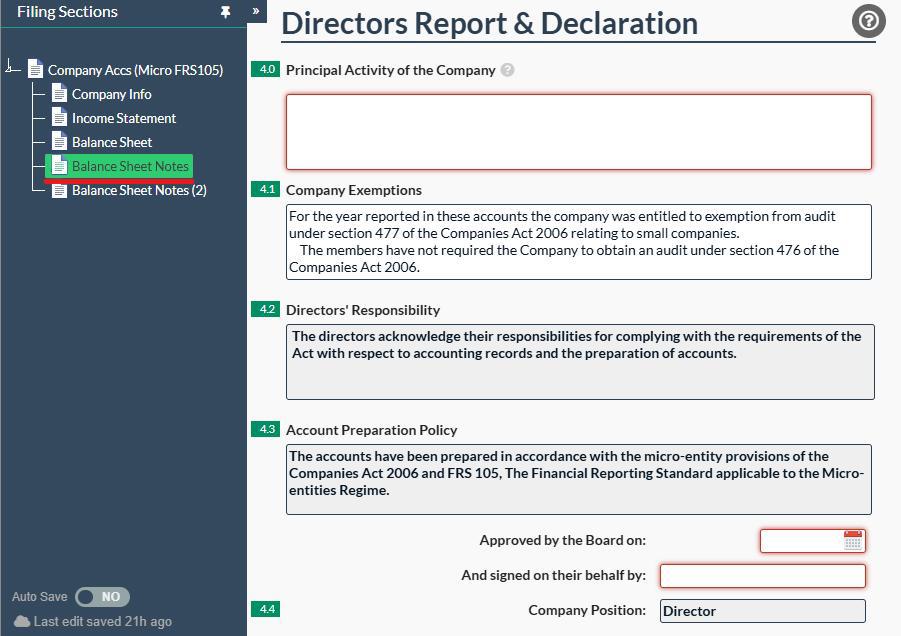
To keep in compliance with Companies House and HMRC, we have included all necessary parts of the audit exemption clauses specified. The clauses can be found on the 'Balance Sheet Notes' page if you are completing the Micro Company IXBRL accounts template, or on the 'Balance Sheet Declaration' page is you are completing the Small Company IXBRL accounts.
Micro Accounts
Within the Micro Accounts, the audit exemption clause is split up into the 3 sections: 'Company Exemptions', 'Director's Responsibility' and 'Account Preparation Policy'.
Small Accounts
Within the Small Company accounts, the audit exemption clause is split up into the 3 sections: 'Audit Exemption', 'Director's Responsibility' and 'Accounting Standard'.
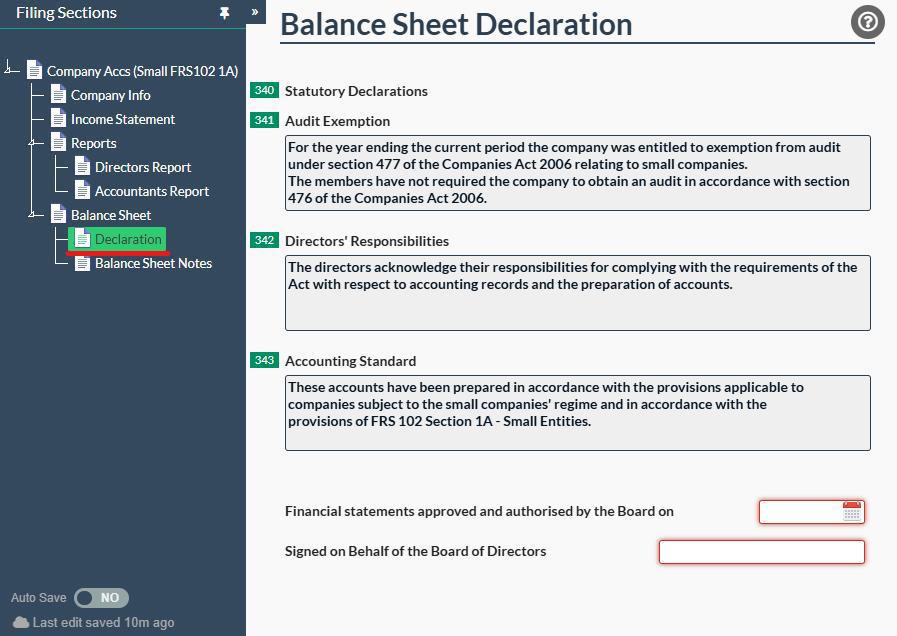
Please note that these boxes can be edited within our system if you desire, however you will need to be aware of the consequences of editing the statements on this page. The declarations comply with Companies House and HMRC's requirements for companies submitting unaudited accounts, so if you are unsure it would be best to leave this section as it is or contact a legal professional.
Can HMRC Investigate Unaudited Accounts?
It's important to be aware that HMRC can investigate unaudited accounts to check to see if they are correct for tax reasons. The absence of an audit does not prevent HMRC from scrutinising the accuracy of your financial records.
If HMRC find that your company returns are filed incorrectly with discrepancies, you may be liable to pay for additional tax that could be owed or further penalties.
Things to Consider
It's important to note that even if your company qualifies as a micro or small entity, it is best to double check that the company fully qualifies for an audit exemption. Some micro or small entities may still be expected to submit audited accounts, so if in any doubt it would be a good idea to seek professional accounting advice.